AI & Tech
Beyond ChatGPT: The New Wave of AI Technology That's Actually Changing How We Work
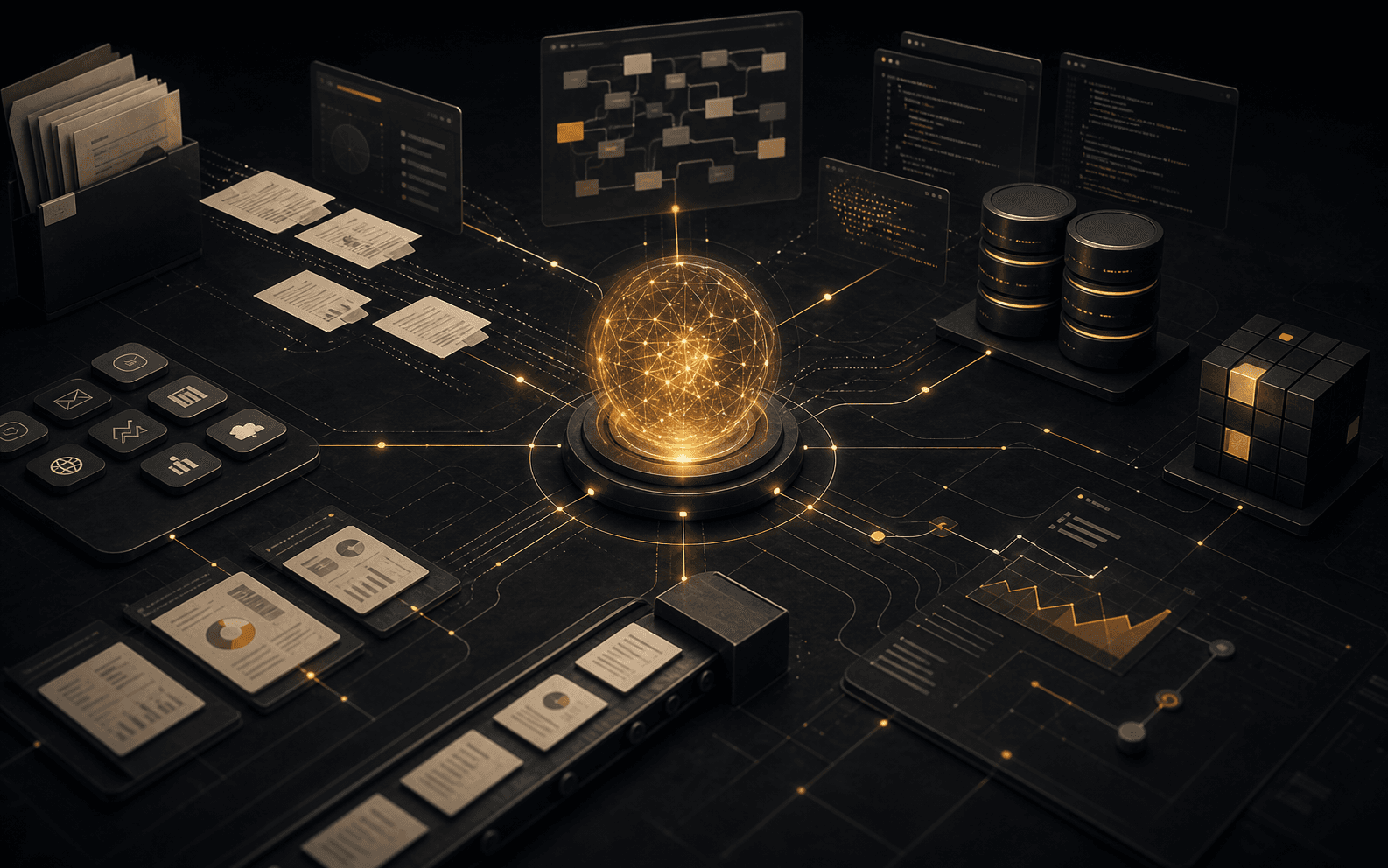
Most conversations about AI still revolve around chatbots — asking a model a question, getting a paragraph back. That was 2023. The AI landscape in 2026 looks fundamentally different, and the gap between public perception and what is actually being deployed in enterprise environments has never been wider.
This is what's really happening — the technologies, the use cases, and the implications for anyone building or working with AI systems right now.
AGENTIC AI: FROM ANSWERING TO ACTING
The single most significant shift in applied AI over the past 18 months is the move from AI as a responder to AI as an actor.
Agentic AI systems do not wait to be asked. They receive a goal — "research competitors, summarise their pricing pages, and draft a comparison report" — and they plan, execute, and iterate across multiple tools and data sources until the goal is complete. No step-by-step prompting. No hand-holding.
Frameworks like OpenAI's Assistants API with function calling, Anthropic's Claude with tool use, Google's Gemini agents, and open-source systems built on LangGraph and AutoGen are making this buildable today without a research team. The architecture involves giving AI agents access to tools — web search, code execution, database queries, API calls — and the autonomy to choose which tools to use and in what sequence.
The practical applications already in production include: automated due diligence in finance, autonomous code review pipelines, multi-step customer support resolution without human escalation, and document-processing workflows that previously required teams of analysts.
The honest caveat: Agentic systems fail in spectacular ways when they encounter edge cases their designers did not anticipate. Building reliable agentic AI is still a hard engineering problem. But the trajectory is clear — the question is no longer whether AI can act, but how to make it act reliably.
MULTIMODAL MODELS: ONE MODEL, EVERY MEDIUM
Twelve months ago, you had a text model, an image model, an audio model. They were separate systems with separate APIs and separate contexts. That separation is dissolving.
GPT-4o, Gemini 1.5 Pro, and Claude 3.5 can natively process and reason across text, images, audio, video, and code within a single context window. A model can watch a screen recording of a software bug, read the error logs, examine the codebase, and produce a diagnosis — all in one inference call.
This is not a cosmetic change. The architecture of AI-powered products is being rebuilt around the assumption that input types are interchangeable. A customer service agent that can see the screenshot the user is describing. A medical AI that reads both a patient's written symptoms and their scan simultaneously. A design tool that takes a hand-drawn sketch and produces production-ready React components.
The bottleneck has moved from model capability to integration architecture. The teams building these products now spend more time on data pipeline design and context management than on prompting.
LONG-CONTEXT WINDOWS AND WHAT THEY ACTUALLY ENABLE
In 2023, a 4,000-token context window was standard. In 2026, Gemini 1.5 Pro operates at 1 million tokens. Claude's extended context reaches 200,000 tokens. GPT-4 Turbo operates at 128,000.
This is technically impressive, but the more important question is what it enables in practice.
The answer is: entire codebases in context. Hour-long meeting transcripts analysed in one pass. Legal contracts compared simultaneously. A novel read and edited holistically. Research papers cross-referenced without chunking.
The chunk-and-retrieve architecture that RAG (Retrieval Augmented Generation) was designed to solve is becoming less necessary for many use cases as context windows expand. For others — those involving private, frequently updated, or extremely large corpora — RAG remains the correct architectural choice.
The practical implication for engineers: the system design question is no longer "how do we get the model to see enough context?" It is increasingly "how do we structure what goes into a 1M token window so the model prioritises correctly?" Context management is the new retrieval engineering.
SMALL, FAST, LOCAL MODELS
While the attention has been on ever-larger frontier models, one of the most consequential developments of the past year is the maturation of small language models — models that run on a laptop, a phone, or an edge device without an internet connection.
Meta's Llama 3, Microsoft's Phi-3, Google's Gemma 2, and Apple's on-device models have demonstrated that a 7B or 8B parameter model, properly trained and quantised, can handle a surprising proportion of real-world tasks with acceptable quality. Not everything — but enough.
The implications are significant. Healthcare applications where patient data cannot leave a device. Financial services with strict data residency requirements. Military and government systems with classified data. Industrial IoT where connectivity is unreliable. Consumer applications where sub-100ms response time is non-negotiable.
The tooling for deploying local models — llama.cpp, Ollama, MLX for Apple Silicon — has matured rapidly. Running a capable language model locally is now a developer task, not a research task.
AI-NATIVE DEVELOPMENT: CODING IS CHANGING PERMANENTLY
GitHub Copilot was a writing assistant for code. What is emerging in 2026 is something categorically different: AI systems that participate in software architecture, not just line-by-line completion.
Cursor, Windsurf, and Replit Agent can hold a codebase in context, understand intent at the architectural level, scaffold entire features from a description, and refactor across hundreds of files. Claude's new computer use capability can navigate a UI to test its own output.
The impact on development teams is real and uneven. Senior engineers who use these tools fluently report 2–4x productivity increases on implementation tasks. Junior engineers report anxiety about whether their skills are keeping pace. The nuanced truth is that the skills being automated fastest are the most rote — boilerplate, documentation, straightforward CRUD operations. The skills increasing in value are architecture, problem decomposition, testing strategy, and — critically — the ability to evaluate and direct AI-generated code.
AI is not replacing software engineers. It is raising the floor of what an individual engineer can produce, which is restructuring team sizes, hiring decisions, and what skills command premium salaries.
REASONING MODELS AND THE END OF "JUST A STOCHASTIC PARROT"
The "stochastic parrot" critique of LLMs — that they are sophisticated pattern matchers without genuine reasoning — was a reasonable characterisation of GPT-3. It is a significantly less accurate characterisation of o1, o3, DeepSeek R1, and the emerging class of reasoning models.
These models allocate variable compute to problems based on difficulty. They generate internal chains of reasoning — "thinking tokens" — before producing an answer, and that internal deliberation measurably improves performance on complex tasks: multi-step mathematics, logical deduction, long-horizon planning, scientific reasoning.
The performance gaps on benchmarks like AIME (competitive mathematics), GPQA (graduate-level science), and complex coding challenges are substantial. On tasks that were considered unsolvable by LLMs two years ago, these models are achieving expert-level results.
This does not mean AI is "thinking" in a human sense. But it does mean the practical ceiling for what AI can reliably do on hard cognitive tasks has risen dramatically and quickly — faster than most commentators anticipated.
THE INFRASTRUCTURE LAYER: WHAT ALL OF THIS RUNS ON
Every capability described above runs on infrastructure that has become commoditised at remarkable speed. AWS Bedrock, Azure AI Studio, and Google Vertex AI give any developer access to frontier models with enterprise-grade security, compliance, and availability — without managing GPU clusters.
The cost of inference has fallen by approximately 100x over the past two years. What cost $10 per 1,000 queries in 2023 costs $0.10 in 2026 for equivalent capability. This cost reduction is not a rounding error — it fundamentally changes which AI applications are economically viable.
Applications that were borderline viable at 2023 pricing — real-time translation, per-document analysis, high-volume customer interactions — are now straightforwardly profitable at 2026 pricing.
WHAT THIS MEANS IF YOU ARE BUILDING
If you are building products or systems that interact with AI, the strategic choices that matter most right now are:
Choose your abstraction level deliberately. Using raw model APIs gives maximum flexibility but maximum maintenance burden. LLM orchestration frameworks (LangChain, LlamaIndex, LangGraph) trade flexibility for speed. Managed AI platforms trade both for simplicity and compliance. Choose based on your team's capabilities and your product's requirements — not on what appears in the most recent conference talk.
Design for model replacement. Every model you build on today will be superseded. Architecture your system so the model is a replaceable component, not a foundational assumption. Abstract the model layer. Version your prompts.
Invest in evaluation infrastructure.
The hardest part of building reliable AI systems is not getting the model to work — it is knowing when it stops working. Automated evaluation, regression testing for AI outputs, and human review pipelines are where most teams underinvest and most failures occur.
Ahmed Fayyaz is an AI Engineer and Full-Stack Developer based in the UK, specialising in enterprise AI integration and agentic system architecture. He holds an MSc in Artificial Intelligence.

AhmedFayyaz