Design & Tech
The Future of UI/UX Design: 7 Trends Reshaping Digital Experience by 2027
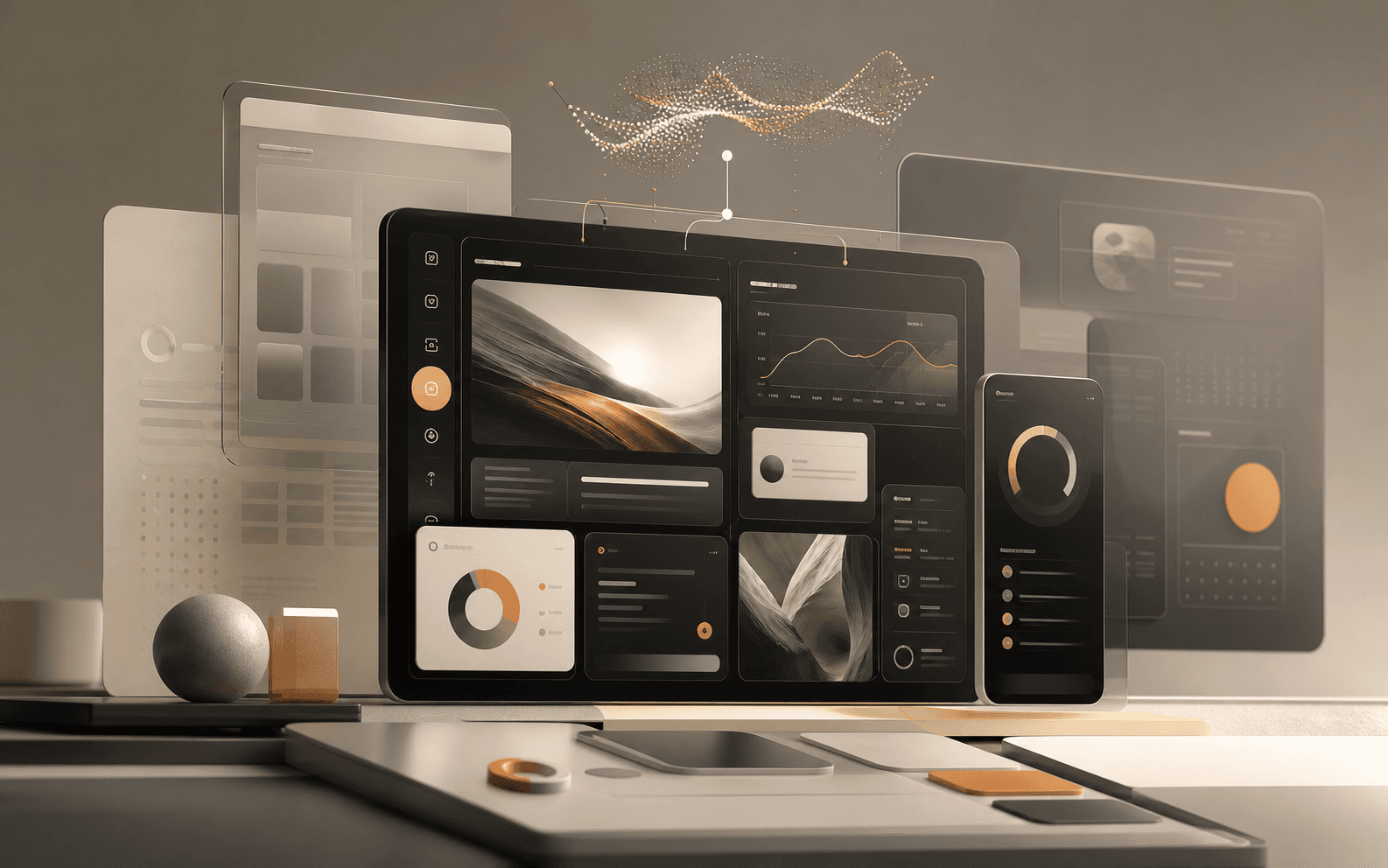
Design is no longer about making things look good. It's about making things feel inevitable — so intuitive, so frictionless, that users forget they're using an interface at all. The next wave of UI/UX is not an evolution. It's a fundamental rethinking of the relationship between human and screen.
Here are the seven trends that are already happening and will define how we build digital products through 2027 and beyond.
1. ADAPTIVE INTERFACES THAT DESIGN THEMSELVES
The static UI — the same layout, the same hierarchy, the same flow for every user — is ending. AI-driven adaptive interfaces observe how individual users behave and reshape themselves around those patterns in real time.
A power user who skips onboarding screens sees a denser information layout. A first-time visitor gets a guided, simplified view. The same product, the same codebase — two completely different experiences.
Tools like Vercel's v0, Galileo AI, and emerging LLM-native design systems are already enabling this at a prototype level. By 2027, shipping a single static layout without adaptive logic will be considered a UX failure in the same way shipping without mobile responsiveness was considered a failure in 2015.
What this means for designers: The job shifts from designing a layout to designing a system of rules. The interface becomes a living document, not a static deliverable.
2. VOICE-FIRST AND MULTIMODAL INTERACTION
Touch is not going away. But it is no longer the primary modality for an increasing number of use cases. Apple Intelligence, Google Gemini Live, and OpenAI's real-time voice API have made conversational interaction genuinely useful — not the clunky voice commands of five years ago, but fluid, contextual, multi-turn dialogue.
The UX challenge is no longer "how do we add a voice button." It's "how do we design an experience that works equally well when eyes are on screen, hands are free, or a user is moving through a physical space."
Multimodal UX — combining voice, gesture, touch, and visual input in a single coherent flow — is becoming a design discipline in its own right. The best practitioners in 2027 will design interaction across input types simultaneously, not as separate modes bolted together.
3. SPATIAL DESIGN AND THE RETURN OF DEPTH
Apple Vision Pro, Meta Quest 3, and a wave of enterprise AR deployments have forced a genuine reckoning with spatial UI. For the first time since the skeuomorphic era, depth, shadow, and three-dimensional placement are functionally meaningful — not decorative.
In spatial interfaces, a card that appears closer to the user communicates urgency. An element placed to the left peripheral signals secondary information. The Z-axis is now a design axis.
Even on flat screens, this thinking is bleeding back in. Designers who understand depth hierarchy, parallax layers, and dimensional composition are designing more legible, more engaging 2D interfaces as a side effect of learning spatial design.
The practical implication now: Start thinking in layers. Understand what your interface looks like if depth were a real property, not a simulated one. This skill is transferable in both directions.
4. MICRO-INTERACTIONS AT SCALE
Micro-interactions are not new. But their sophistication — and their measurable impact on conversion, retention, and satisfaction — has grown dramatically as tooling has improved.
A button that responds to pressure with haptic feedback and a subtle scale animation is not a decoration. It's communicating confirmation, acknowledging the user's action, and reducing perceived latency. Framer Motion, GSAP, and native iOS/Android animation APIs now make these interactions achievable without performance trade-offs.
The trend is toward *emotional feedback at every meaningful touchpoint* — not animation for animation's sake, but motion that carries information. Loading states that tell a story. Transitions that preserve spatial context. Errors that feel human rather than robotic.
Users increasingly experience over-animated interfaces as exhausting and under-animated ones as cold. The discipline of calibrated, purposeful motion is becoming a core UX competency rather than a nice-to-have.
5. RADICAL ACCESSIBILITY AS DEFAULT DESIGN
For years, accessibility has been treated as a compliance checklist — something added at the end, a cost centre, a legal obligation. That framing is collapsing.
The reason is partly ethical. But more practically, the business case has become undeniable. Accessible design is better design. High contrast ratios improve usability for everyone in variable lighting. Keyboard navigation benefits power users, not just screen reader users. Clear typographic hierarchy reduces cognitive load universally.
Increasingly, the most critically acclaimed and commercially successful digital products are those that were designed for edge-case users first and mainstream users second. Constraints produce clarity.
By 2027, the question will not be "did we hit WCAG 2.2?" The question will be "did we design this so a 70-year-old with moderate vision impairment can use it as fluently as a 25-year-old developer?" If the answer is yes, every other user group benefits.
6. PERSONALISATION WITHOUT SURVEILLANCE
Users are tired of feeling tracked. GDPR, App Tracking Transparency, and a decade of headline-grabbing data breaches have fundamentally changed how people feel about their data being collected — even in service of personalised experiences.
The UX challenge of the next three years is delivering intelligent, contextual, personalised experiences using on-device processing and privacy-preserving machine learning — without requiring surveillance-level data collection.
Apple's on-device intelligence framework and Google's federated learning approaches are early answers. The design implication is a shift toward *preference-based personalisation* — the user explicitly tells the product who they are and what they want, rather than the product inferring it by watching behaviour.
This is not a regression. It is a reset that builds genuine trust. Products that get this right will have more loyal users than products that extracted the same personalisation through covert data collection.
7. DESIGN SYSTEMS AS LIVING INFRASTRUCTURE
The design system is not a Figma file that lives in a shared drive. In 2026, a mature design system is a versioned, tested, programmatically generated source of truth that connects design decisions to production code with minimal human translation.
Tokens — not colours, but semantic decisions about what a colour represents — flow from a design tool into code via automated pipelines. A change to a brand colour cascades across every component, every screen, every platform simultaneously.
The designers building these systems are operating closer to software engineers than traditional visual designers. They are writing logic, not just drawing rectangles. The reward is speed, consistency, and the ability to scale a product's visual language across teams, platforms, and languages without losing coherence.
THE THREAD RUNNING THROUGH ALL OF IT
Every trend above points in the same direction: design is becoming less about the artefact and more about the system. Less about how something looks at a fixed moment and more about how it behaves across an infinite range of contexts, users, capabilities, and conditions.
The designers who will lead the next decade are not the ones with the best aesthetic taste. They are the ones who can think in systems, design for variability, and collaborate fluently with engineers and AI tools as co-designers rather than implementers.
The interface of 2027 will feel less like a designed object and more like a well-designed relationship. That is the shift worth preparing for.
Ahmed Fayyaz is an AI Engineer and Full-Stack Developer based in the UK, specialising in intelligent systems that bridge design and engineering. He holds an MSc in Artificial Intelligence.

AhmedFayyaz